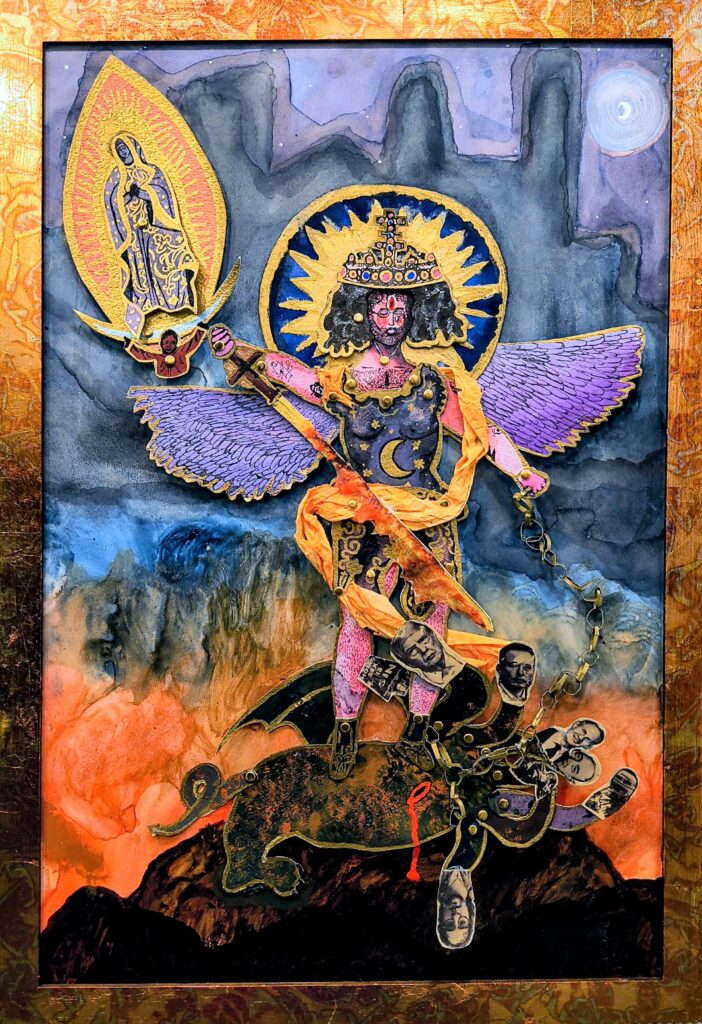
Paul’s work links the iconography of medieval Catholic art to the modern queer experience, accentuating the beauty, pain, and absurdity common to both. Prompted by their Irish-Catholic upbringing on Long Island — in the temporal and geographic shadow of the 1969 Stonewall Riots — the work invents a surreal “Post-Catholicism”, informed by queerness, disability, political theory, and mysticism. This hypothetical faith finds its central metaphor in the overtly yonic depictions of Christ’s wounds that occasionally appear in medieval devotional art. This reinterpretation of canonically masculine bodily suffering as radically feminine, generative, and transformative lies at the heart of Paul’s practice. The work then extends this logic outward, connecting medieval spirituality to the supernatural experiences that pervade modern pop culture, from UFO sightings to ritual magic.
Often working in the spirit of collage, Paul creates fragments from paper, watercolor, and ink. Central among these fragments is the recurring motif of the paper doll, alluding to self-actualization and the performative nature of gender while reclaiming an activity commonly denied to young queer boys. Once recombined and affixed to board, these assemblages are housed in hand-painted ornamental frames, completing their function as Post-Catholic devotional objects. Alongside these assembled objects, Paul also works in a more purely painterly mode, producing works on paper that further explore this Post-Catholic imagery but with a rawness and immediacy distinct from the assembled works. Taken together, the work proposes that transformation — spiritual, bodily, and cultural — has always been a queer act, and that the martyrs of queer history are kindred to the saints of the Catholic past — bound by the same suffering, the same power, and the same refusal to be forgotten.